

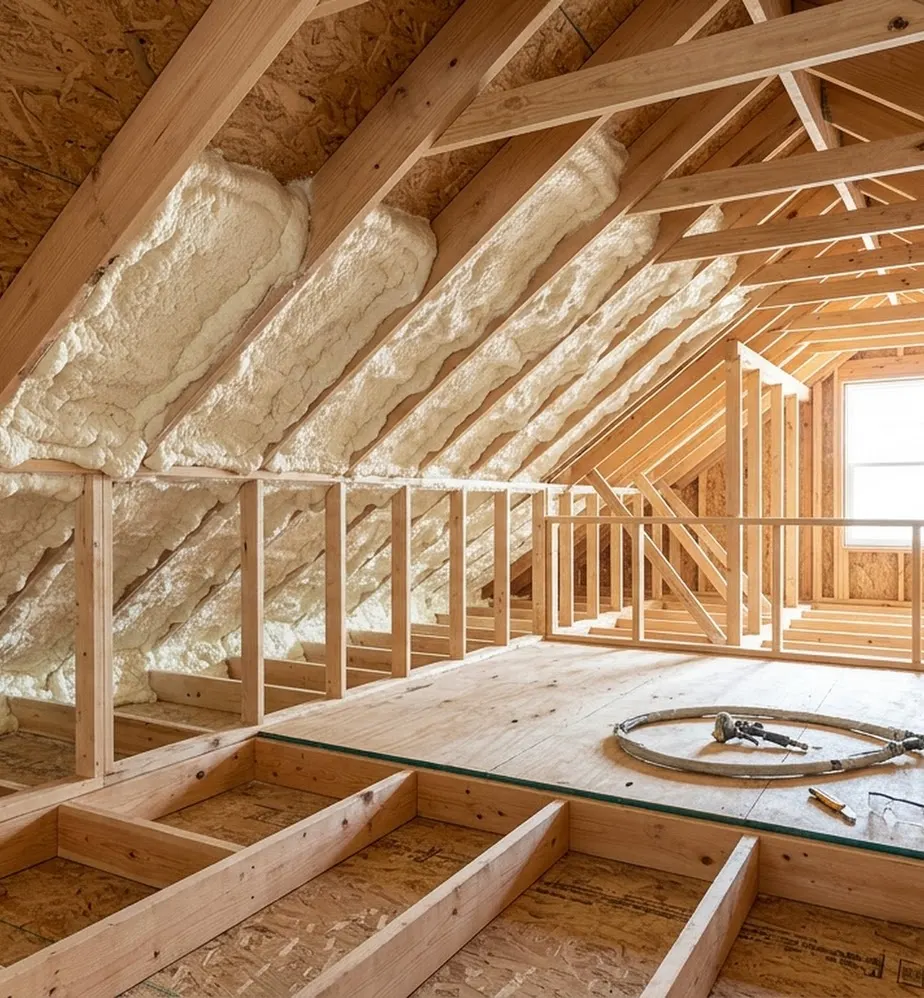
Professional spray foam insulation typically lasts the life of the home, with industry estimates commonly ranging from about 20 years at the low end to 80 years or more when the material is correctly mixed, applied, and protected from moisture and sunlight. Because spray polyurethane foam is a thermoset plastic that cures into an inert, dimensionally stable material, it does not sag, settle, or shift the way batts and loose-fill insulation can, as explained in Wikipedia’s technical overview of spray foam. The real variable is not the calendar; it is the installation. A home insulated by a trained crew with proper quality control can expect decades of stable R-value and airtightness, while a poorly mixed or badly applied job can develop problems within just a few years. Below, we break down what drives longevity, how open-cell and closed-cell foams compare, and how to tell whether the foam in your walls is built to last.
TL;DR
- Expected lifespan: Properly installed spray foam is commonly rated for 80+ years of service, and polyurethane has been used as building insulation since 1979, giving the material nearly five decades of real-world field history.
- Installation quality is the biggest factor: Mix ratio, temperature, humidity, and substrate prep during application determine far more about lifespan than the foam chemistry itself.
- Closed-cell generally outlasts open-cell: Its rigid, sealed-cell structure resists moisture, while open-cell is a softer material recommended mainly for interior, above-grade applications.
- Failed installs fail early: Off-ratio or damp-substrate installations can trap moisture and cause structural damage, which is why incorrect application can destroy a roof and create resale problems.
- Longevity pays off monthly: The EPA estimates homeowners save an average of 15% on heating and cooling costs by air sealing and insulating, savings that compound over decades of foam performance.
- There is no standard removal process: Per the U.S. Consumer Product Safety Commission, misapplied foam is difficult and disruptive to remove, so getting it right the first time matters.
- Most homes benefit: 9 out of 10 U.S. homes are under-insulated, making a long-lasting foam upgrade one of the highest-impact improvements available.
What Determines the Lifespan of Spray Foam Insulation
Spray foam is applied as a liquid that expands 30 to 60 times its volume and cures into place, so its service life is set during the few hours the crew is on site. The factors below separate foam that lasts 80 years from foam that fails in five.
| Factor | Impact on Lifespan | What Good Looks Like |
|---|---|---|
| Mix ratio and equipment calibration | Off-ratio foam cures soft, brittle, or shrinks | Crew verifies ratio and runs test shots before spraying |
| Application conditions | Temperature and humidity during installation affect cure quality, per CPSC guidance | Contractor discusses seasonal timing and weather limits before scheduling |
| Substrate condition | Damp or contaminated surfaces cause adhesion failure and trapped moisture | Surfaces inspected and dried before application |
| Thickness and pass control | Over-thick passes trap heat and cause odors or cracking | Foam applied in controlled lifts to manufacturer specs |
| UV exposure | Sunlight degrades exposed foam over time | Foam covered in attics, rooflines, and exterior applications |
| Building moisture management | Persistent leaks or condensation stress any insulation | Ventilation and vapor strategy designed alongside the foam |
Open-Cell vs. Closed-Cell: Which Type Lasts Longer?
Both foam types are thermoset plastics that hold their form indefinitely once cured, but their density and moisture behavior affect how they age in real homes.
| Attribute | Open-Cell (ocSPF) | Closed-Cell (ccSPF) |
|---|---|---|
| Density | Light, half-pound, sponge-like | Medium, two-pound, rigid |
| Typical R-value | About 3.8 per inch | 5.1 to 6 per inch (long-term thermal resistance) |
| Air barrier | Yes, at 5.5 inches or more | Yes, at minimum installed thickness |
| Vapor barrier | No, vapor-permeable | Yes, at proper thickness |
| Aging behavior | Stays flexible, tolerates minor building movement | Hard, dense structure with strong moisture resistance |
| Best service environment | Interior walls, attics, sound control | Basements, crawl spaces, roofs, exterior-facing assemblies |
| Industry lifespan estimates | 20 years at the conservative end, often matching home life indoors | Commonly cited at 80+ years |
The practical takeaway: closed-cell foam is the durability choice where moisture or physical stress is present, while open-cell delivers long life in interior, above-grade cavities where it stays dry.
Why Installation Quality Outweighs Everything Else
The most instructive longevity story comes from what happens when installation goes wrong. Local spray foam insulation solutions can help ensure the material is installed correctly for the building and surrounding conditions. In the UK, where roughly 150,000 properties have been treated with polyurethane foam, foam applied incorrectly or in damp spaces can trap moisture and destroy the roof, creating problems severe enough that some lenders hesitate on homes with closed-cell foam in the roofline. The material did not fail. The application did.
Federal agencies frame longevity the same way. The EPA describes spray polyurethane foam as a highly effective insulation and air sealant whose outcomes depend on trained applicators, proper ventilation, and controlled re-entry times. The CPSC’s consumer fact sheet recommends homeowners vacate during installation and for at least 24 hours afterward, verify a contractor’s training, licensing, insurance, and references, and ask how temperature and humidity might affect the job. Those questions are not just safety formalities. A crew that controls its environment is a crew whose foam cures correctly and lasts.
Our own process follows the same logic. We calibrate equipment daily, confirm substrate moisture before spraying, apply foam in lifts that cure fully between passes, and document each stage so you know exactly what went into your walls and ceiling.
What Decades of Performance Mean for Your Energy Bills
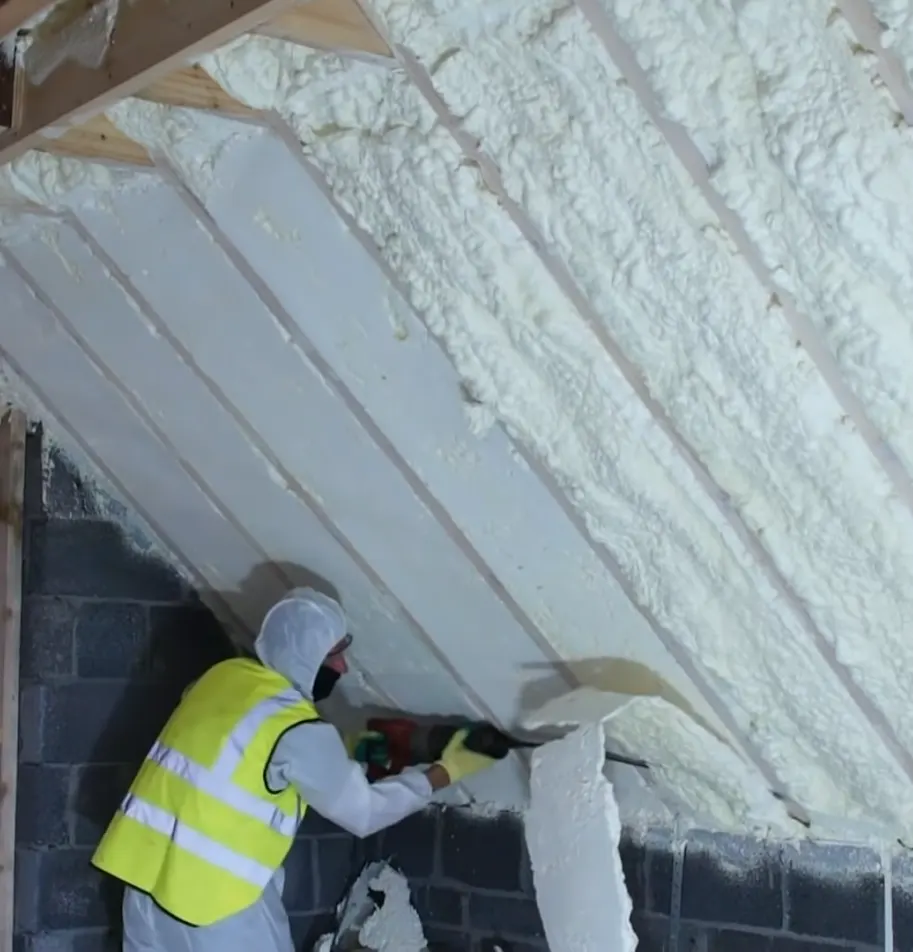
Longevity is what makes spray foam an investment rather than an expense. The Spray Polyurethane Foam Alliance reports that as much as 40% of a building’s energy is lost through air infiltration, and that spray foam addresses it by acting as insulation, an air barrier, and moisture management in a single application, with potential energy bill savings of 5% to 30% per year.
Those savings repeat every month for the life of the material. A conventional batt job that settles after 15 years quietly stops delivering value, while a correctly installed foam envelope keeps its airtightness and R-value decade after decade. The Spray Polyurethane Foam Alliance also notes foam adds structural strength to the building, lowers maintenance demands, and can allow smaller HVAC equipment in new construction, all benefits that persist as long as the foam does.
Warning Signs Your Spray Foam Is Aging Poorly
Healthy spray foam is boring: uniform, firm or springy depending on type, odor-free, and invisible behind drywall. Watch for these indicators instead.
- Persistent chemical or musty odors weeks after installation, which the CPSC flags as a reason to contact your contractor and, if unresolved, bring in an independent indoor air quality expert
- Shrinkage or pulling away from studs and joists, visible as gaps along the edges of cured foam
- Crumbly, soft, or sloughing texture instead of a firm closed-cell or springy open-cell feel
- Returning drafts or uneven room temperatures, a sign the air seal is compromised
- New ice dams along the eaves in winter, which ENERGY STAR identifies as a symptom of air leakage and inadequate insulation
- Moisture staining or condensation near foam in rooflines or basements
Recommendations by Home Scenario
| Scenario | Recommended Approach | Why It Fits | Longevity Notes |
|---|---|---|---|
| New construction | Closed-cell in exterior walls, open-cell in interior and attic planes | Maximizes R-value where moisture risk exists, sound control where it does not | Sets the envelope up for 80+ year performance from day one |
| Existing home retrofit | Closed-cell at rim joists, crawl spaces, and band boards; open-cell in accessible attics | Targets the leakiest zones first | Immediate comfort gains that hold for decades |
| Attic upgrade | Open-cell on the roofline or closed-cell plus ventilation review | Stops the stack effect at its largest source | Foam must stay shielded from UV and attic must breathe properly |
| Basement or crawl space | Closed-cell only | Rigid, moisture-resistant structure handles below-grade conditions | The environment where foam choice matters most for lifespan |
Signs You’ve Chosen the Right Approach and Installer
Based on the federal checklists homeowners are encouraged to use, a trustworthy installation looks like this:
- The crew explains the specific product, its cure behavior, and the plan for every stage before starting
- Weather, temperature, and humidity are discussed as scheduling factors, not ignored
- The work area is isolated, ventilated, and off-limits to occupants and pets until safe re-entry
- Licensing, insurance, and references are offered without prompting
- Thickness, ratio, and coverage are documented, not approximated
- Communication stays open after the job, with a clear process for questions or concerns
Get Foam That Outlasts Your Mortgage
When spray foam is installed right, it is the last insulation your home will ever need, and that outcome depends entirely on who holds the gun. At Springfield Excel Spray Foam, we treat every Springfield, Missouri home like our own, with calibrated equipment, moisture-tested substrates, controlled lifts, and documented quality checks on every job. Whether you are building new, retrofitting an older home, or finally fixing a drafty attic, our team will walk you through the right foam for each space and the timeline you can expect. Call us at (417) 815-4629 or email [email protected].
FAQs
Does spray foam insulation ever need to be replaced?
When properly installed, spray foam is generally expected to last the life of the building, with industry estimates reaching 80 years or more. Replacement is only needed when the original installation was flawed, or the material was physically damaged.
What causes spray foam to fail early?
Off-ratio mixing, application on damp substrates, over-thick passes, and exposure to sunlight are the most common culprits. Each of these is an installation and handling issue, not a flaw in the chemistry itself.
How long before we can go back home after installation?
The CPSC advises vacating during application and for at least 24 hours afterward, with exact re-entry times set by the manufacturer and your contractor. Once cured, the foam is inert and odor-free.
Does spray foam lose R-value over time?
Properly cured foam holds its thermal resistance for decades because the material does not settle or compress. Minor thermal drift occurs in the first months with some closed-cell products, which is why rated long-term values are used for planning.
Can damaged spray foam be repaired?
Yes, small damaged areas can be refoamed after the compromised section is trimmed out, and our crew assesses every repair case individually. There is no standard national removal process for large-scale failures, which is why correct installation from the start is so valuable.
Sources
- Wikipedia – Spray foam – Technical reference covering spray foam chemistry, open-cell and closed-cell R-values, expansion properties, field use since 1979, and documented risks of application in damp spaces.
- EPA – Spray Polyurethane Foam (SPF) Insulation and How to Use it More Safely – Federal guidance on professional installation practices, ventilation, cure safety, and safe re-entry times for spray foam projects.
- CPSC – Spray Polyurethane Foam Insulation: Health and Safety Recommendations for Consumers – Consumer fact sheet covering the 24-hour vacate guidance, contractor vetting checklists, weather-related installation factors, and removal considerations.
- Spray Polyurethane Foam Alliance – Spray Foam Fast Facts – Industry association data on air infiltration losses, energy bill savings, structural benefits, and applicable home efficiency tax credits.
- ENERGY STAR – Why Seal and Insulate? – EPA program estimates showing 15% average heating and cooling savings from air sealing and insulation, plus comfort and ice dam prevention benefits.